
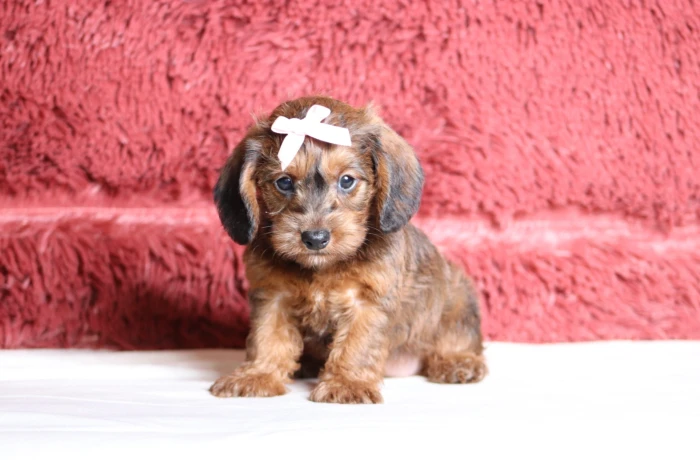
At The Puppy Lodge, we fell in love with the Mini Doxiedoodle the first time we saw what this cross could produce. A Miniature Dachshund paired with a Miniature Poodle creates something that is hard to put into words until you have held one in your arms. These dogs have personality for days. They are smart, affectionate, funny, and small enough to fit into almost any living situation. But they are also a hybrid breed, which means there is more to understand before you commit than there would be with a well-documented purebred that has a hundred years of standardized breeding behind it. That is exactly why we put this guide together.
Our kennel is Purdue University Canine Care Certified, and every Mini Doxiedoodle we produce comes from parents that have been genetically tested and health screened. We also put every puppy through Early Neurological Stimulation from three to sixteen days old, a protocol developed by the U.S. military’s canine program that builds stress tolerance and promotes stronger neurological development. The reason we share this background is that it informs everything you are about to read. This is not recycled breed information from a directory. This is what we know from raising these dogs ourselves, backed by the health testing and care standards that responsible breeding demands.
If you clicked over from our Mini Doxiedoodle page, you already know what our puppies look like and what we stand for as a breeder. This article goes much deeper. We want you to understand the size, the coat, the temperament quirks, the health considerations, and the honest day-to-day reality of living with a Doxiepoo so that when you make your decision, you make it with confidence.
What Exactly Is a Mini Doxiedoodle?
The Mini Doxiedoodle, also commonly called a Doxiepoo, is a designer hybrid that crosses a Miniature Dachshund with a Miniature Poodle. If you have been searching online, you may have also seen names like Dachdoodle, Doxiepoodle, or Doxdoodle. They are all the same cross. We use Mini Doxiedoodle and Doxiepoo because those are the names most families recognize and search for.
Because this is a hybrid and not a standardized purebred, there is more variation from puppy to puppy than you would see in a breed like a Golden Retriever or a Miniature Poodle. Two Mini Doxiedoodles from the same litter can look noticeably different from each other. One might lean more toward the Dachshund side in build, while another might favor the Poodle in coat and face. That unpredictability is part of the charm for many families. Every Doxiepoo is genuinely one of a kind.
In terms of size, most Mini Doxiedoodles land somewhere between ten and twenty pounds and stand roughly eight to fifteen inches tall at the shoulder. They tend to have a longer body influenced by the Dachshund parent. Plus,a more proportionate leg length than a purebred Dachshund, thanks to the Poodle side. The result is a small, sturdy dog that has a distinctive silhouette without the extreme elongation that can cause structural problems in some Dachshund lines. At The Puppy Lodge, we pay close attention to the build and proportions of our breeding dogs because balance matters when you are working with a cross that involves two very different body types.
Temperament: The Best of Two Breeds (and the Honest Challenges)
This is where the Mini Doxiedoodle really wins people over. You are getting the Poodle’s intelligence and eagerness to please. Now combine that with the Dachshund’s loyalty, playfulness, and sheer force of personality. The result is a Mini Doxiedoodle that bonds deeply with its family. Loves to be in the middle of whatever is happening, and has a sense of humor that will catch you off guard daily. Mini Doxiedoodles are the kind of dog that will learn your routine, follow you from room to room, and invent games when they decide you are not paying enough attention to them.
They are also social dogs that generally do well with children and can get along with other pets when properly introduced. Their moderate energy level means they are happy to play and explore but equally content to curl up on the couch with you at the end of the day. For families, singles, and seniors, that adaptability is a huge plus.
Now for the honest part. The Dachshund side of this cross brings a streak of independence that can show up during training. Dachshunds were bred to hunt badgers underground, which required them to make decisions on their own without waiting for a handler’s command. That independent thinking is still wired into the breed, and it can surface in your Doxiepoo as stubbornness. Your dog is not being difficult because they do not understand what you are asking. They understand perfectly. They are deciding whether or not they feel like cooperating. Patience, consistency, and positive reinforcement are the tools that work. Harsh corrections will shut a Mini Doxiedoodle down faster than almost any other approach.
The other thing to know is that this mix tends to be vocal. Both Dachshunds and Poodles are alert dogs that like to announce visitors, strange noises, and anything else they find interesting. Your Doxiepoo will likely be a barker, especially if they are bored or understimulated. This is manageable with training and mental engagement, but if you live in an apartment with thin walls, it is worth having a plan in place from day one. At The Puppy Lodge, we begin socialization early so our puppies are exposed to a range of sounds and situations before they go home. That early exposure helps build confidence and reduces the reactivity that drives excessive barking.
The Coat: What to Expect and How to Care for It
One of the most interesting things about Mini Doxiedoodles is that their coat can vary significantly. Even within a single litter. Some puppies inherit a coat that is curly and dense like a Poodle’s. Other puppies end up with a wavy, softer texture that falls somewhere between the two parent breeds. Occasionally, a puppy will lean more toward the Dachshund side with a straighter, shorter coat. You will not know exactly what you are getting until the puppy’s adult coat comes in, which typically starts happening around six to eight months.
The good news is that most Mini Doxiedoodles shed very little compared to the average dog, especially those with curlier or wavier coats. That Poodle influence on the coat is a big part of why this cross appeals to families who deal with allergies. As with all dogs, no Doxiepoo is completely hypoallergenic, but many allergy sufferers find they can live comfortably with this mix.
Grooming requirements depend on the coat type your puppy ends up with. Curlier coats need brushing two to three times a week at minimum to prevent matting and tangling. A slicker brush is a good tool to have. This breeds wavy coats are a bit more forgiving but still benefit from regular brushing to keep them clean and tangle-free. Professional grooming every four to six weeks is a good rule of thumb for most Doxiepoos, especially those with Poodle-dominant coats. The puppy cut, which is a short, even trim all over, is the most popular and practical choice for family pets.
Beyond coat care, there are a few grooming details that tend to get overlooked with this breed. Mini Doxiedoodles often inherit the Dachshund’s floppy ears. Their floppy ears on a Mini Doxiedoodle can trap moisture, possibly creating a potential breeding ground for ear infections. Check and clean their ears weekly, especially after baths or swimming. Dental care is a priority, because smaller breeds are more prone to dental issues. Both the Dachshunds and Poodles are predisposed. Brushing your dog’s teeth at home with a dog-safe toothpaste several times a week can prevent problems that would otherwise require expensive veterinary cleanings down the road. Nail trimming every few weeks rounds out their grooming routine.
On the topic of colors, Mini Doxiedoodles can come in a wide range of them. Litters can have a variety of Colors, Including Black, white, cream, brown, red, and gray, and various mixed patterns are possible. The color your puppy ends up with depends entirely on the genetics of the parents, and because both Dachshunds and Poodles carry diverse color genes, the possibilities are broad. At The Puppy Lodge, we can give you a good idea of what colors to expect from any given litter based on the parents, but with a hybrid cross, there is always an element of surprise.
Health, Lifespan, and the Conversation About Backs
Mini Doxiedoodles typically live twelve to fifteen years, which is a strong lifespan for a small hybrid breed. Many live well beyond that range with dedicated care. This includes offering good nutrition and regular veterinary attention for your Doxiedoodle. The combination of two different gene pools often gives hybrid dogs what breeders call hybrid vigor. This means a general tendency toward better overall health compared to some purebred lines. That said, hybrid does not mean bulletproof. There are specific health concerns that every Mini Doxiedoodle owner should understand.
The biggest one is Intervertebral Disc Disease, commonly called IVDD. This is a spinal condition that affects roughly one in four purebred Dachshunds. The discs between the vertebrae degenerate, which can bulge or even rupture, putting pressure on the spinal cord. It causes pain, mobility issues, and in severe cases, paralysis. Because the Mini Doxiedoodle inherits some of the Dachshund’s longer body structure, IVDD risk is something every owner needs to take seriously.
The practical steps to reduce IVDD risk are straightforward. Keep your Doxiepoo at a healthy weight. Extra pounds can put added stress on a dog’s spine. Avoiding activities that involve a lot of jumping, especially on and off furniture, is helpful. Using a ramp for couches and beds if your dog likes to be up high. Limit stair use when possible. Support your dog’s body with both hands when you pick them up, rather than letting their back dangle. And stay alert for early warning signs like reluctance to move, yelping when touched, an arched back, or a lowered head posture. Early detection and veterinary intervention make a significant difference in outcomes.
This is where the breeder you choose makes a real difference. Genetic testing of the parent dogs can identify carriers of conditions like PRA before a litter is ever produced. Health screening for joint and spinal issues adds another layer of protection. At The Puppy Lodge, every breeding dog in our Mini Doxiedoodle program is fully genetically tested and health screened. We stand behind our puppies with a three-year health guarantee because we have done the work upfront to give every puppy the healthiest possible start. That is not a sales pitch. It is a standard that every responsible breeder should meet.
What Daily Life with a Mini Doxiedoodle Looks Like
Mini Doxiedoodles have a moderate energy level, which means they need regular activity, but they are not going to require you to run five miles a day. About thirty to forty-five minutes of exercise spread throughout the day keeps most Doxiepoos happy and healthy. A morning walk, some playtime in the yard or living room, and an evening stroll is a realistic routine for most families. These dogs also enjoy interactive toys and puzzle games that challenge their minds, which is just as important as physical exercise for a breed this smart.
One thing that catches new owners off guard is how attached Mini Doxiedoodles become to their people. Both Dachshunds and Poodles are breeds that bond tightly with their families, and when you combine the two, you get a dog that wants to be with you constantly. That is wonderful when you are home, but can be a problem when you are not. Separation anxiety is a real concern with the Doxiedoodles. In these dogs, it tends to manifest as destructive behavior, excessive barking, or bathroom accidents when the dog is left alone for extended periods. Crate training, gradual alone-time practice, and ensuring your puppy gets enough exercise and mental stimulation before you leave the house all help manage this tendency.
For apartment and condo living, the Mini Doxiedoodle is a strong choice. Their small size means they do not need much space, and their moderate exercise needs can be met without a yard. They are clean, low-shedding dogs that do not carry much odor. The barking tendency is the main consideration in a shared-wall living situation, and that can be managed with proper training and enrichment. For houses with yards, they will enjoy the outdoor time, but keep in mind that the Dachshund heritage gives some Doxiepoos a strong digging instinct. A flower bed might become a construction site if you are not watching.
One practical note: Mini Doxiedoodles tend to prefer warmer environments. Their small size and the Dachshund’s low-to-the-ground build mean they can get cold more easily than larger dogs. In cooler climates, a dog coat or sweater for winter walks is not just fashionable. It is functional. They can absolutely live in colder regions, but they will appreciate the extra layer when temperatures drop.
The Bottom Line
The Mini Doxiedoodle may not be a dog for everyone. But for families and individuals who want a small, smart dog with a deeply affectionate, supersize personality, the Doxiepoo is hard to beat. They bring the Poodle’s intelligence, they have a low-shedding coat, together with the Dachshund’s loyalty, warmth, and sense of adventure. The result is a dog that fits into apartments and houses, gets along with kids and other pets, and will make you laugh every single day.
We wrote this guide because the Mini Doxiedoodle is still a relatively new cross, and there is not as much reliable information out there as there should be. At The Puppy Lodge, we want every family that considers this breed to understand both the rewards and the responsibilities. When you know what to expect, you set yourself and your dog up for the best possible life together. If you still have questions after reading this, we are always here to talk. That is what we do.