
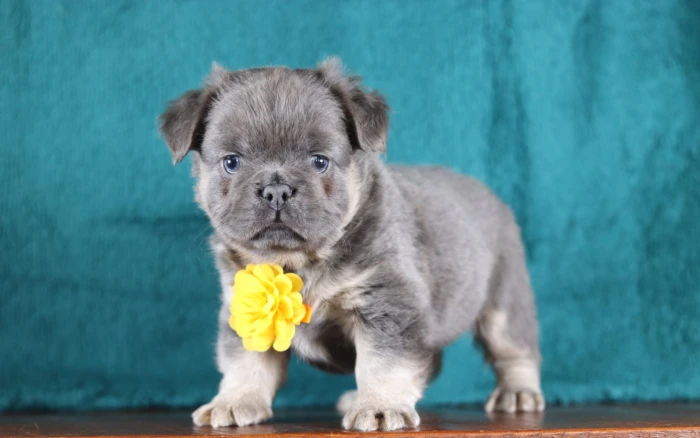
The first time most people see a Fluffy Frenchie in person, they stop in their tracks. It looks like someone took everything lovable about a French Bulldog and wrapped it in a soft, plush coat that you cannot stop touching. The bat ears, the compact build, the expressive face, the personality that fills a room. It is all there. It just happens to come with fur that makes you do a double-take.
At The Puppy Lodge, our Fluffy French Bulldogs are one of the most asked-about breeds we carry, and for good reason. These dogs combine everything that made the French Bulldog the most popular breed in the country with a coat that is unlike anything most people have seen on a Frenchie before. But because the Fluffy Frenchie is still relatively new to the spotlight, there is a lot of confusion out there about what they are, where the coat comes from, and whether they are even purebred. We hear those questions all the time, and we are happy to answer every single one of them.
Our kennel is Purdue University Canine Care Certified, and every Fluffy Frenchie we produce comes from parents that have been genetically tested and health screened. We know the genetics behind our dogs inside and out. This article is not a surface-level overview pulled from a directory. It is a deep look at the breed from a team that raises these dogs, tests these dogs, and stands behind every puppy with a three-year health guarantee. Plus, every puppy receives Early Neurological Stimulation (ENS) from days 3 to 16. If you are considering a Fluffy French Bulldog, this is the information you need before you make that decision.
What Exactly Is a Fluffy French Bulldog?
A Fluffy Frenchie is a purebred French Bulldog that carries two copies of a recessive gene that produces a longer, softer coat. That gene is called the Fibroblast Growth Factor 5 gene, or FGF5 for short. In breeding circles, it is usually referred to as the Lh gene, which stands for long hair. The specific variant found in French Bulldogs is known as L4, and it has been part of the French Bulldog gene pool for as long as the breed has existed. This is not something that was introduced by crossing Frenchies with another breed. It is a natural genetic variation that has been present in the breed for generations.
Here is how the genetics work in plain terms. Every French Bulldog carries two copies of the gene that controls coat length. If a dog inherits two copies of the short hair version, it has a standard short coat. If it inherits one short hair copy and one long hair copy, it still has a short coat but carries the fluffy gene and can pass it on to offspring. Only when a dog inherits two copies of the long hair variant does the fluffy coat appear. Both parents must carry at least one copy of the Lh gene for a Fluffy Frenchie puppy to be possible. When two carriers are bred together, roughly one in four puppies will be fluffy. When a fluffy dog is bred with a carrier, about half the litter will be fluffy. This is basic recessive genetics, and it is why Fluffy Frenchies are rarer than standard French Bulldogs.
The question we hear most often is whether Fluffy Frenchies are really purebred. The answer is yes. Modern genetic testing through companies like Orivet and the UC Davis Veterinary Genetics Laboratory can confirm breed ancestry and verify the presence of the L4 variant. A true Fluffy French Bulldog will test as 100 percent French Bulldog with two copies of the long hair gene. There is no Pekingese mixed in. There is no Chihuahua or Pomeranian hiding in the bloodline. The fluffy coat is simply a part of the French Bulldog’s own genetic makeup that was historically considered undesirable by show breeders but has always been there.
It is worth noting that the AKC breed standard calls for a short, smooth coat, which means Fluffy Frenchies cannot compete in conformation shows. But they can still be AKC registered as purebred French Bulldogs, and they are eligible for every other AKC event including obedience, agility, and rally. The show ring disqualification has zero impact on the dog’s health, temperament, or quality as a family companion. It simply reflects a standard that was written long before the pet-owning public fell in love with the fluffy coat.
The Coat: What Makes It Different and How to Care for It
The fluffy coat is longer and softer than a standard Frenchie’s coat, but it is not dramatically long. Most Fluffy French Bulldogs have fur that is roughly two to three times longer than a standard Frenchie’s short, smooth coat. The hair tends to be most noticeable around the ears, chest, neck, and tail, giving the dog a softer, almost teddy bear-like appearance. The texture is fine and silky rather than coarse or wiry. It is the kind of coat that people cannot resist running their hands through, and the dogs seem to know it.
Grooming a Fluffy Frenchie is more involved than grooming a standard French Bulldog, but it is far less demanding than what you would deal with on a breed like a Poodle or a Shih Tzu. Brushing two to three times a week with a soft slicker brush keeps the coat tangle-free and looking its best. The longer fur around the ears and chest can mat if it is neglected for too long, so consistency matters. Giving a bath every 3 to 4 weeks is usually sufficient, unless your dog gets dirty, stinky, or super messy. Giving your dog a professional groom every 6 to 8 weeks keeps everything trimmed and tidy, though the fluffy coat does not require the elaborate haircuts that curly-coated breeds need.
One grooming detail that applies to all French Bulldogs, fluffy or not, is skin fold care. Frenchies have wrinkles on their face, especially around the nose and under their eyes. Those folds can trap moisture and create conditions for bacterial or yeast infections if they are not kept clean and dry. Simply wiping with a soft cloth or a pet safe facial wipe once a day takes care of it. Make it part of your daily routine and it becomes second nature. Ear cleaning matters too. Those iconic bat ears are open and upright, which means they can collect dust and debris. Being diligent, checking weekly, and gently cleaning with a vet-approved ear solution keep infections at bay.
Fluffy Frenchies come in a wide range of colors. Cream, fawn, brindle, pied, blue, lilac, and various combinations of these are all possible depending on the genetics of the parents. Some of the rarer color combinations, like lilac or blue, tend to be especially popular with Fluffy Frenchie enthusiasts because the longer coat shows off those unique tones beautifully. At The Puppy Lodge, we can tell you what color combinations to expect from a given litter based on the genetic testing of the parents, and we are always happy to walk you through what that testing means.
Temperament: The Same Lovable Frenchie Personality, Just Fluffier
If you have ever spent time around a French Bulldog, you already know what you are getting with a Fluffy Frenchie. The coat is different. The personality is the same. These are affectionate, playful, easygoing dogs that want nothing more than to be near their people. They will follow you from room to room, curl up on the couch next to you, and somehow manage to take up far more space than a dog their size should reasonably occupy. They are comedians. They make faces. They snore on your pillow. They become part of the family in a way that few other breeds can match.
French Bulldogs have consistently ranked as the most popular dog breed in America in recent years, and a huge part of that is temperament. These dogs are adaptable. They do well in apartments, condos, and houses. They are happy with singles, couples, families with kids, and seniors. They get along with other pets when properly socialized. They do not need a yard or hours of exercise to be content. They are low-key enough to fit into a busy lifestyle but engaged enough to make every day more interesting. The Fluffy Frenchie inherits all of this.
There is a mild stubborn streak that comes with the Frenchie breed, and you should expect it. French Bulldogs are smart, but also independent thinkers. Training works best when it is kept short, positive and fun with a Frenchie. If a Frenchie decides they are done with a training session, pushing harder usually doesn’t help. Consider high-value treats, a playful tone, and patience to go a long way. Most Fluffy Frenchies respond well to consistent positive reinforcement. Once they learn something, they tend to remember it. They are not the fastest learners in the dog world, but they are reliable once the lesson sticks.
One thing that surprises some new Frenchie owners is how social these dogs are. They love being around people and can become quite attached to their families. That attachment is one of the breed’s best qualities, but it also means that Fluffy Frenchies do not love being left alone for long stretches. If your household is empty for eight or ten hours a day, this breed may struggle with that. They do best in homes where someone is around for at least part of the day, or where they have a companion animal to keep them company. When they are happy and stimulated, they are the easiest dogs in the world to live with.
Size, Build, and What to Expect as They Grow
Fluffy French Bulldogs are the same size as standard French Bulldogs. The AKC breed standard lists the maximum weight at 28 pounds. Most Frenchies generally weigh between 16 and 28 pounds as adults. They stand approximately 11 to 12 inches tall at the shoulder. The fluffy coat can make them look slightly larger than they are, but underneath that fur is the same compact, muscular build that defines the breed. They are small dogs with a solid, sturdy frame and a low center of gravity. They feel heavier than they look when you pick them up, and that is because they are densely built with substantial bone.
Frenchies reach their full height by around 9 to 12 months, but they continue to fill out and add muscle until they are closer to 2 years old. During the growth phase, it is important to keep their weight in a healthy range. French Bulldogs are prone to carrying excess weight, which puts added strain on their joints and respiratory system. A simple vet visit can help you determine the ideal weight for your individual dog based on their frame. A lean, fit Frenchie is a healthier, more comfortable Frenchie. Managing their weight from puppyhood is one of the simplest things you can do to set them up for a long life filled with happiness.
Health: Understanding the Breed
French Bulldogs are a brachycephalic breed, which simply means they have a shortened skull and a flat face. This distinctive look is a large part of their appeal, but it also comes with health considerations that every owner needs to understand. Being informed is not about being scared off. It is about being prepared to provide the best possible care.
The most significant health consideration for all French Bulldogs is their respiratory system. Brachycephalic Obstructive Airway Syndrome, or BOAS, refers to a group of anatomical features that can restrict airflow in flat-faced breeds. The shortened muzzle means the soft tissues of the nose and throat are compressed into a smaller space. Which can cause noisy breathing, snoring, and reduced ability to cool down through panting. The degree to which this affects any individual French Bulldog varies. Some Frenchies will breathe easily and have minor issues. Others may benefit from a veterinary evaluation. While in some cases, surgical correction to open the airways is necessary. At The Puppy Lodge, we are selective about our breeding dogs and prioritize structure that supports healthier breathing. Choosing a breeder who pays attention to airway health is one of the most important decisions you can make.
Heat sensitivity goes hand in hand with respiratory considerations because French Bulldogs are less efficient at cooling themselves through panting than longer-nosed breeds. This means they are more susceptible to overheating when walking or playing outside in hot weather. To prevent overheating, try taking walks early in the morning and late in the evening when it’s cool. Keeping their exercise sessions short, in the shade, on cool surfaces, and with fresh water is important. On very hot days, keeping them indoors with air-conditioning is the safest option. A cooling vest can also be a very helpful tool for dogs that spend time outdoors. The fluffy coat does add a small amount of insulation, but the heat sensitivity comes from the airway structure, not the fur, so the same precautions apply whether your Frenchie is fluffy or standard.
Beyond the respiratory system, there are a few other health topics to have on your radar. Not all, but some French Bulldogs are prone to skin allergies, both environmental and food-related. The skin folds on their face need regular cleaning to prevent infections. There are two joint conditions, such as hip dysplasia and patellar luxation, that can occur in the breed, though they are less common in well-bred dogs from health-tested parents. Spinal issues, including hemivertebrae and intervertebral disc problems, are something to be aware of because of the breed’s compact build. Eye conditions such as cherry eye or corneal ulcers can occasionally occur in flat-faced breeds. And dental health deserves attention because a shortened jaw can lead to crowded teeth, which can make them more at risk for tartar buildup and gum disease.
This is where your choice of breeder makes a real difference. Genetic testing can identify carriers of many hereditary conditions before a litter is ever produced. Health screening of the parents adds another layer of protection. At The Puppy Lodge, every breeding dog in our Fluffy Frenchie program is fully genetically tested and health screened. We stand behind every puppy with a three-year health guarantee because we have done the upfront work to give each puppy the healthiest start possible. Responsible breeding does not eliminate all risk, but it dramatically reduces it, and it is the standard that every breeder should meet.
What Daily Life with a Fluffy Frenchie Looks Like
One of the biggest reasons French Bulldogs have become so popular is that they fit into almost any lifestyle. Fluffy Frenchies are low-energy dogs compared to most breeds. They do not need long runs, hours at the dog park, or a massive backyard to be happy. Two or three short walks a day, some indoor playtime, and a good amount of couch time is a perfectly fulfilling day for a Frenchie. That makes them an outstanding choice for apartment living, for people who work from home, and for anyone who wants a companion that is content to be near you without demanding constant activity.
That said, they do need some exercise and mental engagement. A bored Frenchie can become a destructive Frenchie, and those powerful jaws can do more damage to a shoe or a couch cushion than you might expect from a 25-pound dog. Puzzle toys, short training sessions, and interactive play keep them mentally stimulated and their behavior in check. The good news is that it does not take much. A ten-minute training session or a new puzzle feeder is enough to tire out most Frenchies mentally, and a mentally tired Frenchie is a content, well-behaved Frenchie.
Fluffy Frenchies are also remarkably quiet compared to many small breeds. They are not big barkers. They will alert you if someone is at the door, but they are not the type to bark at every passing car or squirrel. This makes them particularly well-suited to apartment and condo living, where a noisy dog can be a concern. Their calm, adaptable nature means they tend to settle in quickly to new environments and handle changes in routine without a lot of stress.
On the topic of travel, Frenchies are one of the more portable breeds out there because of their compact size and easygoing temperament. They do well on car rides and adapt to new environments quickly. The one consideration is air travel. Because of their brachycephalic structure, French Bulldogs can have difficulty with the changes in air pressure and temperature that come with flying, and many airlines have restrictions on flat-faced breeds in cargo. If you plan to travel with your Fluffy Frenchie, ground travel or cabin seating on airlines that allow it is the safest approach.
A Brief History: Where Fluffy Frenchies Come From
The French Bulldog’s story begins in England in the early 1800s with miniature versions of the English Bulldog. When lace workers from Nottingham were displaced by the Industrial Revolution and relocated to northern France, they brought their small Bulldogs with them. Those dogs became wildly popular in France, especially in Paris, where they were crossed with local ratters and developed into the breed we recognize today. By the late 1800s, the French Bulldog had its own identity, complete with the signature bat ears that American fanciers insisted upon as the breed standard when the French Bulldog Club of America was founded in 1897.
The fluffy coat has been part of the gene pool since those early days. Some breeders believe the long hair gene was introduced through the local French ratters, which may have carried longer coats. Others think it was already present in the English Bulldog lines. Either way, the Lh gene has been documented in the breed for as long as genetic testing has been available to look for it. For most of the breed’s history, fluffy puppies were considered undesirable because they did not match the short, smooth coat described in the show standard. Some were quietly removed from breeding programs. It was not until the last decade or so that pet owners and breeders began to appreciate the fluffy coat for what it is: a beautiful, natural variation within a beloved breed.
Today, the Fluffy Frenchie is one of the fastest growing segments of the French Bulldog world. Demand has skyrocketed, and with it has come a need for breeders who approach these dogs with the same commitment to health, genetic testing, and responsible practices that any quality breeding program requires. At The Puppy Lodge, we saw the appeal of the Fluffy Frenchie early on and made the decision to build our program the right way from the start, with tested parents, health screening, and the same Purdue-certified standards we apply to every breed we raise.
The Bottom Line
The Fluffy French Bulldog is not just a pretty coat. It is the same adaptable, affectionate, endlessly entertaining breed that has won over millions of families, wrapped in a look that turns heads everywhere you go. They are low-maintenance on the activity front, wonderful with families, and small enough to fit into any living situation. The health considerations that come with the breed are real but manageable, especially when you start with a puppy from health-tested parents and a breeder who knows what they are doing.
We wrote this guide because the Fluffy Frenchie is still new enough that accurate information can be hard to find. At The Puppy Lodge, we want every family that considers this breed to understand the genetics, the grooming, the health picture, and the day-to-day reality of living with one of these dogs. Fluffy Frenchies will give you years of companionship, laughter, and a level of devotion that is hard to find in any other breed. If you still have questions after reading this, reach out to us. We are always happy to talk Frenchies.