
A Lifestyle-Based Guide from The Puppy Lodge
Getting a puppy is one of the most exciting decisions a family can make. It is also one of the easiest to get wrong. People usually fall in love with a photo, a cute face, a viral video, and before they have asked a single practical question or done any research, before they purchase a puppy. Then reality sets in quickly, like the puppy breed they chose needs more exercise than they expected, or the shedding is relentless. Another big one is that the breed’s energy level does not match the family’s lifestyle. Or maybe the breed’s temperament, which looked so fun on video, turns out to be a challenge for their particular household. None of these scenarios means the dog is a bad dog, it just means it wasn’t a good breed match from the beginning.
We hear this at The Puppy Lodge more than we would like, and it is one of the main reasons we invest so much time in education before a family ever takes a puppy home. We raise seven different breeds, each with a distinctly different personality, energy level, size, and grooming requirements. There is no single breed that is right for everyone, and there is no breed that is wrong for everyone either. The right match depends entirely on your life, your space, your schedule, your experience, and what you actually want the day-to-day reality of dog ownership to look like.
This guide walks you through the questions that matter most and helps you figure out which breed fits you, not the other way around. We are a Purdue University Canine Care Certified breeder, and every breed we raise goes through our Early Neurological Stimulation program and comes from genetically tested, health-screened parents. The standard of care is the same across the board. The only question is which dog belongs in your home.
Start with Your Living Space
The amount of indoor and outdoor space you have is not the whole story, but it is a real factor. Some breeds really do need room to move, and some are perfectly content in a tiny apartment as long as their other needs are met. Being honest about your living situation immediately saves everyone a lot of frustration down the road.
If you live in an apartment, a condo, or a smaller home without a yard, your best options are breeds that do not require much space to burn off energy. Teddy Bears are one of the most apartment-friendly breeds that exist. At 9 to 15 pounds, they take up very little room, they have moderate energy that is easy to satisfy with short walks and indoor play, and they are not excessive barkers. Fluffy Frenchies are another outstanding apartment breed. They are compact, low-energy, and content to lounge on the couch for most of the day. Miniature Poodles and Miniature Dachshunds also do well in smaller spaces, though both need a bit more mental stimulation to stay happy indoors. Mini Doxiedoodles, at 10 to 20 pounds, are similarly apartment-compatible as long as they get their daily exercise and are not left alone for long stretches.
If you have a house with a yard, all seven of our breeds will thrive. But the two that truly benefit from more space are the Golden Retrievers and Pomskies. Golden Retrievers are active, athletic dogs that weigh 55 to 75 pounds and need room to run, fetch, and play. They can adapt to smaller spaces if you are committed to daily outdoor exercise, but they are happiest with a yard . Pomskies are escape artists with energy to spare, and a securely fenced yard gives them freedom to burn it off between structured walks. If your yard has gaps in the fence or low spots, fix them before bringing a Pomsky home. They will find every weakness.
Be Honest About Your Energy Level
This is where many mismatches occur. A high-energy breed in a low-energy household leads to a bored, destructive dog and a frustrated owner. A low-energy breed with an active, outdoorsy family leads to a dog that cannot keep up. Neither situation is fair to the dog or the owner. The goal is alignment.
If you want a calm, relaxed companion that is happy with a couple of short walks and a lot of couch time, the Fluffy Frenchie and the Teddy Bear are your top picks. Fluffy Frenchies are one of the most laid-back breeds you will find anywhere. Two to three short walks a day and some indoor playtime is all they need. Their brachycephalic build actually means they should not be over-exercised, especially in warm weather. Teddy Bears are similarly easygoing. Thirty minutes to an hour of total daily activity keeps them content. These are dogs that match well with seniors, people who work from home, or families that prefer a quieter lifestyle.
If you want a dog breed with moderate energy that keeps you active, the Miniature Poodle, the Miniature Dachshund, and the Mini Doxiedoodle are good choices. Miniature Poodles are athletic, smart, and happy, and they enjoy a good walk and some interactive play or training each day. They need mental stimulation just as much as physical exercise to keep them from being bored. Miniature Dachshunds only need about 30 to 45 minutes of daily activity, but they also enjoy exploring and sniffing everything on walks. You should avoid activities that strain their backs, such as jumping or climbing stairs. Mini Doxiedoodles need similar activity; they do best with variety in their routine.
If you are an active person or a family searching for a dog that fits your outdoor lifestyle, the Golden Retriever and the Pomsky are your breeds. Golden Retrievers need a solid hour or more of exercise every day and are happiest when they are running, swimming, fetching, or hiking alongside you. They are the classic adventure dog. Pomskies need 45 minutes to an hour of daily activity and thrive with interactive play, training games, and new environments to explore. Both of these breeds will match your energy stride for stride, but they will also let you know when they are not getting enough of it.
Does Anyone in Your Home Have Allergies?
No dog is completely hypoallergenic. That is a myth the dog world needs to retire. What is true is that some breeds produce significantly fewer allergens than others because they shed less and have coats that trap dander rather than releasing it into the air. If allergies are a factor in your household, the type of coat matters a lot.
The Teddy Bear, Miniature Poodle, and Mini Doxiedoodle are your best options. Teddy Bears inherit their low-shedding coat from both the Bichon Frise breed and the Shih Tzu, two breeds known for being allergy-friendly. Miniature Poodles have a single-layer curly coat that sheds minimally and is widely considered one of the most hypoallergenic coats in the dog world. Mini Doxiedoodles get their low-shedding tendency from the Poodle side, though the coat can vary depending on which parent the puppy favors. If allergies are severe, spending time with the specific puppy before committing is always a good idea.
On the other end of the spectrum, Golden Retrievers and Pomskies are heavy shedders. Golden Retrievers have a heavy double coat that sheds year-round with heavier seasonal blowouts. Pomskies shed daily and blow their entire undercoat twice a year in dramatic fashion. If anyone in your family has dog allergies, these two breeds will likely be a problem. Miniature Dachshunds fall somewhere in the middle. They shed moderately, especially the longhaired variety, but they produce more dander than the low-shedding breeds. Fluffy Frenchies shed lightly compared to standard French Bulldogs, but their longer coat continues to release some dander. They are not the best choice for severe allergy sufferers, but may work for mild sensitivities.
How Old Are Your Children?
Every breed we raise can be a wonderful family dog. But the ages of your children should influence which breed you choose, because the combination of a very young child and a very small dog creates risks for both.
If you have toddlers or young children under six, the Golden Retriever is the best choice. Goldens are patient, gentle, forgiving of rough handling, and sturdy enough that a toddler accidentally sitting on them is not going to cause an injury. They are the breed most commonly recommended for young families for a reason. Their size and temperament make them remarkably tolerant of the commotion that small children bring. Teddy Bears are also excellent with young kids because of their kind, patient nature, but their smaller size means you need to supervise more closely to make sure the dog is not accidentally hurt. The same applies to Fluffy Frenchies, who adore children but are compact enough that rough play could easily hurt the dog.
If your children go to school or are older and understand how to handle a dog respectfully, every breed will be a good choice. Miniature Poodles are wonderful with older kids because they love interactive play and learning tricks together. Pomskies bond well with active kids who can help burn off their energy. Miniature Dachshunds are loyal and playful companions for children who understand that they need to be careful with the dog’s back. Mini Doxiedoodles bring a mix of playfulness and affection that clicks well with families where the kids are old enough to participate in training.
One thing to consider, regardless of the breed, is that all interaction between a young child and a dog should be supervised. Even the most patient, gentle breed has limits, and even the best-behaved child can accidentally cross a boundary. Teaching kids how to approach, pet, and respect a dog is just as important as training the dog itself.
How Much Time Will the Dog Spend Alone?
This question does not get asked often enough, and it should be one of the first things you consider. Some breeds handle alone time well. Others fall apart without company. If your household is empty for eight or more hours on a typical day, that reality needs to shape your choice.
Golden Retrievers are one of the most independent breeds when it comes to being alone. They prefer having company, but a well-exercised Golden with room to move around and a few toys can handle a normal workday without major issues. Miniature Dachshunds are also self-reliant. They are independent by nature, and while they enjoy your company, they do not typically develop separation anxiety that companion breeds do.
On the other hand, Teddy Bears, Fluffy Frenchies, Mini Doxiedoodles, and Pomskies all have a stronger tendency toward separation anxiety. Both parent breeds of the Teddy Bear were developed specifically to be close to their owners at all times, and that instinct runs deep. Fluffy Frenchies thrive on companionship and can become anxious or possibly destructive when left alone for long periods. Mini Doxiedoodles inherit separation anxiety tendencies from the Dachshund side and a bonding instinct from the Poodle side, creating a dog that really does not want you to leave. Pomskies get bored and anxious without stimulation, and a lonely Pomsky can be a very vocal, very creative destroyer of household items.
Miniature Poodles fall somewhere in the middle. They bond strongly with their owners, but they are also intelligent enough to settle into a routine if you build alone time gradually and provide enrichment like puzzle feeders and rotating toys.
If your household has someone home most of the day, or if you work from home, any breed will thrive. If the house is regularly empty, lean toward the Golden Retriever or the Miniature Dachshund, or make plans to build alone-time tolerance slowly with the companion breeds. Crate training, a consistent departure routine, and a dog walker or midday visit is able to bridge the gap for breeds that need more social contact.
How Much Grooming Are You Willing to Do?
Every dog needs some grooming. But there is a wide range between what some breeds require and what others demand, and underestimating the grooming commitment is one of the fastest ways to end up frustrated or spending more at the groomer than you budgeted for. Be realistic about how much time and money you are willing to invest in coat care.
The lowest-maintenance coat in our lineup belongs to the Miniature Dachshund, especially the smooth-coated variety. A good weekly brushing and occasional bath is all they need. Longhaired Dachshunds require a bit more attention to prevent tangles, but they are still far less demanding than the other breeds.
Fluffy Frenchies need brushing at least twice a week, plus regular attention to their skin folds, which should be wiped daily to prevent infections. Their grooming is not intensive, but skin-fold care is a non-negotiable daily habit that needs to be done. Golden Retrievers need regular grooming a few times a week to manage their shedding, plus occasional baths. They do not require professional grooming haircuts, but during shedding season you will want a good deshedding tool and possibly a professional blowout.
The highest grooming commitment is required for the Teddy Bear, Miniature Poodle, Mini Doxiedoodle, and Pomsky. Teddy Bears need daily brushing to prevent mats, professional grooming every four to six weeks. They need regular attention to tear staining around their eyes. Miniature Poodles need professional grooming every four to six weeks and regular brushing between appointments to keep their curly coat from matting. Mini Doxiedoodles have similar requirements depending on how much Poodle influence shows in their coat. Pomskies do not need haircuts, but their thick double coat requires a good brushing two to three times a week and constant management during their twice-yearly coat blowout, when fur comes off in clumps for weeks at a time.
Here is the honest reality: if you are not willing to brush your dog regularly and budget for professional grooming, the Miniature Dachshund, the Golden Retriever, or the Fluffy Frenchie will be an easier fit. If you enjoy grooming as part of your routine and see it as bonding time, the higher-maintenance breeds are absolutely worth it.
How Important Is a Quiet Dog?
If you live in an apartment with thin walls, have neighbors in close proximity, or simply value a quiet home, the noise level of a breed matters more than most people realize before they bring a puppy home.
The quietest breeds in our lineup are the Fluffy Frenchie and the Teddy Bear. Fluffy Frenchies are not big barkers. They will alert you if someone is at the door, but they are not the type to bark at every sound or movement. Teddy Bears are also quiet. They are calm, easygoing dogs that communicate more with body language than with their voice. Golden Retrievers are generally pretty quiet, but will bark when excited or when someone arrives; they are not constant or nuisance barkers.
Miniature Dachshunds and Mini Doxiedoodles are a step up on the barking scale. Dachshunds were bred as hunting dogs originally, and have a quite loud bark for their size. They will alert you to everything happening in and around your home, and training can manage but not fully eliminate that instinct. Mini Doxiedoodles inherit some of that vocal tendency. Miniature Poodles are generally quiet but can become barkers when bored or understimulated.
And then there is the Pomsky. Pomskies are vocal dogs. They bark, they yip, and they howl. The howling comes from their Husky heritage, and it is not something you can fully train out of them. For the right owner in the right living situation, it is endearing and entertaining. For apartment living with sensitive neighbors, it is a serious consideration. If noise level is a priority for you, the Fluffy Frenchie or the Teddy Bear is the safer choice.
Is This Your First Dog?
Some breeds are forgiving of mistakes and easy for new owners to figure out. Others have traits and needs that benefit from experience. There is no shame in being a first-time dog owner, but choosing a breed that suits your experience level sets you up for success instead of a steep learning curve.
The best breeds for first-time owners in our lineup are the Golden Retriever, the Teddy Bear, and the Fluffy Frenchie. Golden Retrievers are consistently eager to please, highly trainable, and patient. They are the breed that makes you feel like you know what you are doing, even when you are still figuring things out. Teddy Bears are gentle, responsive to positive reinforcement, and do not have any extreme behavioral tendencies that catch new owners off guard. Fluffy Frenchies are laid-back, easy to train with patience and treats, and their low exercise needs mean there is less to manage overall.
Miniature Poodles are a great choice for first-time owners who are willing to invest in mental stimulation and regular grooming. They are smart and trainable, but they need their brains engaged, or they will find their own entertainment. Miniature Dachshunds and Mini Doxiedoodles both carry a stubborn streak from the Dachshund side that can test a new owner’s patience when training. They are absolutely manageable, but they require consistency and a sense of humor about the process.
Pomskies are the breed we would most recommend to experienced dog owners. Their combination of intelligence, stubbornness, energy, vocalization, and escape artistry means they need an owner who knows how to set boundaries, stay consistent with training, and provide the structure they need. A first-time owner can absolutely succeed with a Pomsky, but they should go in with a clear understanding and a plan for professional training if needed.
What Is Your Climate Like?
Ohio weather does not faze any of our breeds, but if you live in a particularly hot or cold climate, it should factor into your choice.
Cold climates are ideal for the Pomsky, which has a thick double coat built for frigid temperatures. Golden Retrievers also handle cold weather well with their dense coat. Miniature Dachshunds, on the other hand, get cold easily. Their low body, thin coat, and small size mean they need a sweater or jacket for winter walks in colder regions. Mini Doxiedoodles share some of that cold sensitivity depending on their coat type.
Hot climates require caution with any of the double-coated breeds. The Fluffy Frenchie demands the most attention because of their brachycephalic airway structure makes it harder for them to cool themselves through panting, and overheating is a genuine safety concern. If you live somewhere hot, your Fluffy Frenchie needs early morning and late evening walks, air conditioning, and careful monitoring during the summer months. Pomskies and Golden Retrievers also need heat management because of their thick coats, but they have normal airway structures that allow them to regulate their temperature more effectively. Teddy Bears and Miniature Poodles handle warm weather reasonably well because of their smaller size and single or low-shedding coats.
Quick-Reference Breed Snapshots
Golden Retriever: 55 to 75 pounds. High energy. Heavy shedding. Outstanding with young children. Needs a yard or a daily commitment to outdoor exercise. Best for active families, first-time owners, and homes with young kids. Lifespan 10 to 12 years.
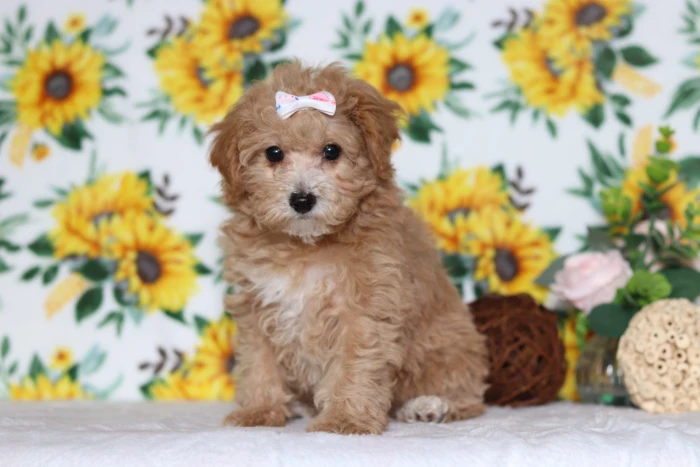
Teddy Bear(Shichon): 9 to 15 pounds. Have low to moderate energy, low-shedding, hypoallergenic, and gentle. Great for apartment living, seniors, allergy sufferers, and children of any age. Needs daily brushings and scheduled grooming. Lifespan 12 to 16 years.
Fluffy French Bulldog: 16 to 28 pounds. Low energy. Light shedding, Laid-back and affectionate. Ideal for apartments, low-activity households, and first-time owners. Needs daily skin fold care and heat management in warm climates. Lifespan 10 to 12 years.
Miniature Poodle: 10 to 15 pounds. Moderate energy. Minimal shedding, hypoallergenic. Highly intelligent and trainable. Great for allergy sufferers and owners who enjoy training. Needs a professional grooming every four to six weeks. Lifespan 12 to 15 years.
Miniature Dachshund: 8 to 11 pounds. Moderate energy, medium shedding, bold, loyal, and independent. Good for apartments and smaller homes. Fragile backs require the use of ramps and prevent jumping. Can be stubborn in training. Lifespan 12 to 16 years.
Mini Doxiedoodle (Doxiepoo): 10 to 20 pounds. Moderate energy. Low shedding. Intelligent but independent. Good for apartments and families. Prone to separation anxiety. Needs mental stimulation and gradual alone-time training. Lifespan 12 to 15 years.
Pomsky: 15 to 35 pounds. Moderate to high energy. Heavy shedding with seasonal blowouts. Vocal, intelligent, and loyal. Best for experienced owners and active households. Needs a securely fenced yard, daily exercise, and consistent training. Lifespan 12 to 15 years.
The Right Breed Is the One That Fits Your Real Life
The best puppy for your family is not the one that looks the cutest in a photo. It is the one whose energy matches yours, whose size fits your space, whose grooming needs match your willingness to maintain them. The temperament needs to match your household and day to day activity. When those things line up, everything else falls into place. Training is easier because the dog’s natural tendencies match your lifestyle rather than conflicting with it. Health is easier to manage because you are prepared for the breed-specific needs. And the bond you build is stronger because neither you nor the dog is constantly frustrated by a mismatch.
At The Puppy Lodge, we are always happy to talk through these decisions with you. We know our breeds inside and out because we raise them every day, and our goal isn’t just to sell a puppy. Our goal is to make the right match. Every puppy we raise comes from genetically tested parents, goes through our Early Neurological Stimulation program, and is backed by a three-year health guarantee. The standard of care is the same no matter which breed you choose. The only question is which one is right for you. Give us a call at 330-790-5007 or send us a message, and we will help you figure it out.