
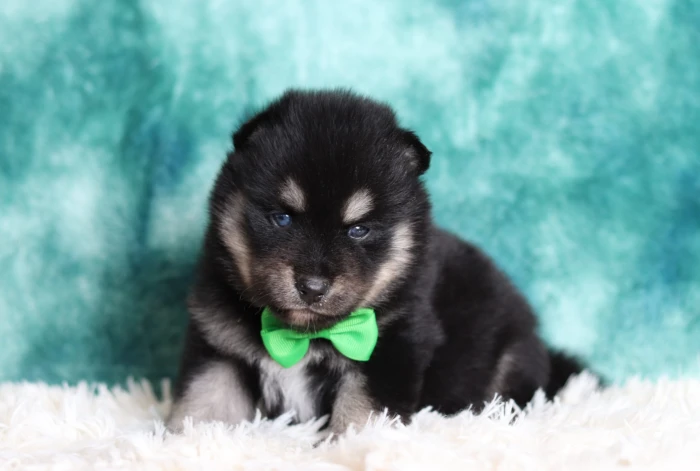
Picture a Siberian Husky shrunk down to a size that fits in your lap, with the same striking blue eyes, the same thick coat, the same wolf-like markings, and a personality that is somehow even bigger than the original. That is a Pomsky. Part Pomeranian, part Siberian Husky, and entirely their own thing. These dogs look like miniature wolves, act like they are the most important creature in any room, and have a talent for making people stop mid-sentence to ask what breed they are.
At The Puppy Lodge, Pomskies are one of our most exciting breeds to raise and one of the most frequently misunderstood. The internet made Pomskies famous practically overnight and with that fame came a flood of misinformation, unrealistic expectations, and a lot of people who fell in love with a photo without understanding what the real dog behind it needs. This guide is here to fix that. We are going to walk you through everything, from how the breed came to exist, to what size you can actually expect, to the shedding situation you need to be prepared for, to the health picture every Pomsky owner should understand.
Our kennel is Purdue University Canine Care Certified. We genetically test and health screen every breeding dog. Every Pomsky puppy we raise goes through our Early Neurological Stimulation program from three to sixteen days old, building stress tolerance and confidence from the very beginning of their lives. We know this breed because we live with this breed, and everything in this article reflects that hands-on experience.
What Is a Pomsky and How Did This Breed Happen?
A Pomsky is a designer hybrid created by crossing a Siberian Husky with a Pomeranian. If that pairing sounds unusual given the size difference between those two breeds, you are right. It is unusual, and it is the reason Pomskies are always produced through artificial insemination rather than natural breeding. The mother is always the Siberian Husky and the father is always the Pomeranian, which keeps both the mother and the puppies safe during pregnancy and delivery.
The Pomsky’s origin story is one of the more entertaining ones in the dog world. In 2011, a Buzzfeed blog post went viral that featured photos of Finnish Lapphund puppies, incorrectly labeled as Pomeranian-Husky mixes. The internet went wild. People wanted one immediately. Breeders saw the demand and got to work making it real. The first intentional Pomsky litters were born in March of 2012 from breeders in Arizona, and the breed has been growing in popularity ever since. It is still a very young breed, which means the standards, the predictability, and the understanding of long-term health are all still evolving.
The Pomsky dog is not recognized by the American Kennel Club because it is a mixed breed, but there are dedicated registries and organizations working toward formal recognition. The American Pomsky Kennel Club and the Pomsky Club of America are the two largest. Both organizations have been developing breed standards and promoting health testing among Pomsky dog breeders. The Pomsky breed is registered with the Dog Registry of America as well.
Both parent breeds come from the Spitz family. This is why the cross works as well as it does. The Spitz dog breeds share common traits. Things such as erect ears, thick double coats, curled tails, and a confident, independent temperament. The Siberian Husky was bred as a sled dog in northeastern Asia, built for endurance and teamwork in extreme cold. The Pomeranian descends from larger Spitz-type sled dogs that were bred down in size over centuries in the Pomerania region of modern-day Poland and Germany. So when you look at a Pomsky, you are actually looking at two branches of the same family tree that converged back together.
Generations Explained: Why It Matters What You Are Getting
One of the most important things to understand about Pomskies is the generation system, because it directly affects what your puppy will look like, how big it will get, and how predictable its traits will be. Not all Pomskies are the same mix, and the generation tells you how far removed your puppy is from the original Husky-Pomeranian pairing.
An F1 Pomsky is a first-generation cross, meaning one parent is a purebred Siberian Husky and the other is a purebred Pomeranian. This is the 50/50 mix and the most unpredictable. Puppies from the same F1 litter can look completely different from one another. One might lean heavily Husky in appearance, while its littermate looks much more Pomeranian. Size can also vary widely in F1 litters.
An F1B is a Pomsky bred back to one of the parent breeds. If an F1 Pomsky is crossed with a purebred Pomeranian, the result is a smaller dog with more Pomeranian influence, roughly 75 percent Pomeranian and 25 percent Husky. This is a common approach for breeders who want to produce smaller Pomskies with more predictable sizing.
An F2 Pomsky comes from two F1 Pomsky parents. F3 comes from two F2 parents, and so on. With each successive generation, traits become more consistent and predictable. By the time you reach F3 or F4, breeders can produce litters where size, coat type, and temperament are much more uniform. At The Puppy Lodge, we can tell you exactly what generation each of our Pomsky puppies is and what that means for your expectations.
Size, Build, and What They Actually Look Like
This is the question everyone asks first, and the honest answer is that Pomsky size varies more than almost any other breed. Three size categories are recognized by the American Pomsky Kennel Club: the Standard, the Mini, and the Toy Pomsky. Standard Pomskies weigh 20 to 35 pounds and stand 12 to 18 inches tall. Mini Pomskies weigh 12 to 20 pounds and stand up to 14 inches tall. Toy Pomskies weigh under 15 pounds and are less than 10 inches tall. Most Pomskies fall in the 15 to 25 pound range, making them a comfortable medium-small dog.
The ideal Pomsky looks like a miniature Husky with a slightly fluffier, rounder Pomeranian influence. Alert triangular ears that sit high on the head. A thick, plush double coat. A curled tail carried over the back. Bright, expressive eyes that can be brown, amber, green, hazel, gray, or the striking ice blue that Huskies are famous for. Some Pomskies even have heterochromia, where each eye is a different color, or parti eyes where a single eye contains multiple colors. It is one of the most visually distinctive traits a Pomsky can have.
Coat colors run across a wide spectrum. The classic Husky markings of gray and white or black and white are the most recognized, but Pomskies also come in red and white, brown and white, pure white, pure black, sable, agouti, merle, brindle, and various other combinations. Patterns can include the Husky’s signature facial mask or be more uniform. Because of the genetic variety in this cross, no two Pomskies look exactly alike, and that unpredictability is part of the fun for many owners.
Temperament: Big Personality in a Smaller Package
If you are expecting a laid-back lap dog, the Pomsky will surprise you. These dogs inherited confidence, intelligence, and energy from both sides of their family tree, and they are not shy about showing it. Pomskies are playful, curious, loyal, and very attached to their people. They want to be involved in everything you do, and they will let you know if they feel left out. The Pomeranian side contributes boldness and a certain fearlessness that can be comical in a dog this size. The Husky side adds intelligence, independence, and a desire for activity and stimulation.
And then there is the voice. This might be the single most important temperament trait that prospective Pomsky owners need to understand. Both Pomeranians and Siberian Huskies are vocal breeds, and the Pomsky inherits that tendency in full. They bark. They yip. And yes, they howl. Hearing a small fluffy dog let out a full Husky howl is equal parts hilarious and startling, especially if you are not expecting it. They are not constant barkers in the way some small breeds can be, but they are communicators. They will talk to you when they are excited, when they want something, when they hear a noise outside, and sometimes just because they have something to say. For apartment living, this is worth serious consideration. Training can manage the volume to some degree, but you will never fully silence a Pomsky, and you should not try to. It is part of who they are.
Pomskies are intelligent dogs that learn quickly, but they also carry the stubbornness that both parent breeds are known for. Training needs to start early, stay consistent, and rely on positive reinforcement. They are very treat-motivated, which gives you a strong tool for shaping behavior, but they can also decide they are done with a training session and simply check out. Short, engaging sessions work much better than long repetitive drills. Early socialization is equally important. Pomskies bond strongly with their families and can be wary of strangers or unfamiliar dogs without proper exposure during puppyhood.
Separation anxiety is a real consideration with this breed. Pomskies form deep attachments and do not enjoy being left alone for long periods at a time. This boredom and loneliness can lead to destructive behaviors. Also, the dog can develop excessive barking habits and escape attempts that would make their Husky parent proud. To avoid this good crate training, puzzle toys, a consistent routine, and gradual alone-time practice are all essential. Our Early Neurological Stimulation program at The Puppy Lodge gives puppies a head start on stress tolerance, but ongoing work at home is still needed to build a confident, well-adjusted adult.
Exercise and Energy: More Than You Might Expect
Do not let the smaller size fool you into thinking this is a low-energy dog. Pomskies have a moderate to high energy level. This means they need daily physical and mental exercise to stay happy and well-behaved. A bored Pomsky is a creative Pomsky, and their creativity tends to involve chewing things, digging things, and finding ways out of things. Plan for at least 45 minutes to an hour of activity per day, split between walks, playtime, and mental stimulation.
They love interactive playtime. So fetch, tug, puzzle toys, and training games all work well. They also enjoy exploring new environments, which means varied walking routes keep things interesting for them. Despite their energy, most Pomskies will adapt to your activity level over time, as long as the baseline of daily exercise is met. They can live comfortably in apartments if their exercise needs are fulfilled, though a house with a securely fenced yard gives them more freedom to burn off energy on their own schedule. The emphasis on securely fenced is important. The Husky influence means Pomskies can be escape artists, and a fence that does not go to the ground or has gaps is an invitation, not a barrier.
The Coat: Beautiful, Thick, and Yes, It Sheds
There is no gentle way to say this: Pomskies shed. A lot. They have a thick double coat inherited from two breeds that were built for cold climates, and that coat needs to go somewhere when the seasons change. Twice a year, typically in the spring and the fall, Pomskies blow their undercoat. This is not normal shedding. This is clumps of fur coming off in handfuls for several weeks. If you are not prepared for it, it will feel like your dog is falling apart. They are not. It is completely normal, and a trip to the groomer for a deshedding treatment and blowout makes a big difference.
Outside of blowout season, Pomskies still shed daily, just at a more manageable level. Brushing two to three times a week with an undercoat rake or slicker brush keeps loose fur under control and prevents matting. Pay special attention to the areas behind the ears, under the armpits, and on the backs of the legs, which are prone to tangles. Bathing a Pomsky once a month is generally sufficient unless your dog gets dirty more often.
The American Pomsky Kennel Club recognizes three coat types. The standard coat is under one inch long and actually sheds the most individual hairs despite looking shorter. The plush coat is one to two and a half inches, fluffier with longer hair on the tail, ears, and legs. The woolly coat is three inches or longer, the most dramatic looking but also the most maintenance-intensive, requiring brushing several times a week and a sanitary trim every couple of months.
One critical rule: never shave a Pomsky. The Pomsky’s double coat acts as insulation against both cold and heat, protects against sunburn, and serves as a barrier against insects and plant irritants. Shaving disrupts the coat’s natural structure and can cause it to grow back improperly. If your Pomsky seems warm in summer, provide shade, fresh water, and limit exercise during the hottest parts of the day. The coat is doing its job.
Health and Lifespan: What the Science Says So Far
Pomskies are a generally healthy breed with an expected lifespan of 12 to 15 years. Because the breed has only existed since 2012, the long-term health data is still limited compared to well-established breeds. What we do know comes from the health profiles of both parent breeds and the data that organizations like the American Pomsky Kennel Club have been collecting through open health surveys. The good news is that the vast majority of Pomsky owners report no significant health problems. The conditions worth understanding are the ones that show up in Huskies and Pomeranians individually, because there is always a chance they can be passed to the cross.
Hip dysplasia is the most commonly discussed concern. This is a joint condition where the socket and ball of the hip do not develop properly, leading to pain, reduced mobility, and eventual arthritis. This is more commonly associated with larger breeds, but the Husky influence makes it relevant for Pomskies as well. Responsible breeders screen for this through OFA certification of the parents, and maintaining a healthy weight and appropriate exercise levels throughout your dog’s life helps reduce the risk and slow any progression.
Patellar luxation is a disease that comes from the Pomeranian side of this dog breed. This condition is where the kneecap slips out of its normal groove. This causes the dog to skip a step or hold the leg up momentarily. Some mild cases may not require treatment beyond weight management. The more severe cases can need surgery. Having the parents evaluated before breeding, like we do here at The Puppy Lodge. This significantly reduces the chances of this condition being passed on to the puppy.
Eye conditions deserve attention. This is because the Siberian Husky is one of those breeds that is most prone to inherited eye problems. Juvenile cataracts can appear as early as three months old and may progress to vision loss. Progressive retinal atrophy is a degenerative condition. This gradually reduces vision over time. Corneal dystrophy affects the cornea’s clarity. A CERF eye exam of the breeding parents helps screen for these conditions before they are passed to the next generation.
Dental disease is a concern carried over from the Pomeranian breed. Which is prone to plaque buildup and some gum problems, like many small breeds. Performing regular tooth brushing at home, at least three times a week and ideally daily, combined with professional dental cleanings on your vet’s recommended schedule, is the best prevention. Dental disease goes beyond cosmetic concerns. If this condition is left untreated, bacteria that infect the gums can enter the bloodstream, affecting the heart, kidneys, and liver.
Collapsing trachea is another Pomeranian-linked condition worth mentioning. The tracheal rings that hold the windpipe open can weaken over time, causing coughing and breathing difficulty. This is one of the reasons we recommend using a harness rather than a collar for walks. A collar attached to a leash puts pressure directly on the neck and throat, which can contribute to or worsen tracheal issues. A harness distributes that pressure across the chest instead.
Allergies, both environmental and food-related, show up in some Pomskies. Symptoms can include itchy skin, recurring ear infections, hair loss, sneezing, or digestive problems. Working with your vet to identify triggers and adjust the diet or environment accordingly makes management effective in most cases. At The Puppy Lodge, genetic testing and health screening of every breeding dog is how we reduce these risks from the start. We stand behind every Pomsky puppy with a three-year health guarantee. This is because we have done the work before the pups are ever born.
What Daily Life with a Pomsky Looks Like
Living with a Pomsky is living with a dog that has many opinions, so much energy, and an endless capacity to make you laugh. The Pomsky are entertaining in a way that few breeds can match. They will tilt their head when you talk to them, howl along with sirens, invent their own games, and find ways to be the center of attention even when you are trying to focus on something else. They bring a lightness and a humor to daily life that Pomsky owners describe as addictive and fun.
The Pomsky breed does extremely well in homes where someone is around for most of the day. Also, having a canine companion to keep them company can make a difference for the dog. They can adapt to being alone for a normal workday with proper crate training and routine, but they are not dogs that thrive in isolation. They need interaction, stimulation, and a sense of being part of the family.
Feeding is important to get right because Pomskies can be prone to weight gain, and extra weight stresses joints that may already carry genetic risk. A high-quality food formulated for their size and activity level, fed in measured portions on a schedule, is the best approach. Some Pomskies can be picky eaters, which is not uncommon when the Pomeranian influence is strong. Mixing a small amount of wet food with kibble often solves that. Your vet can help you dial in the right calorie intake based on your individual dog’s size and energy level.
Their thick coat means they are naturally suited to cooler climates and do very well in cold weather. In hot climates, you will need to be mindful of heat management. Early morning and late evening walks, access to shade and fresh water, and air-conditioned indoor time during the heat of the day keep them comfortable and safe. They are not a breed that should be left outside in high temperatures.
The Bottom Line
The Pomsky is not the easiest breed to own and it is not the right fit for everyone. But for the right person or family, it is definitely one of the most rewarding. You get a dog that looks like nothing else on the block. That has a personality that fills up a room, and bonds with you in a way that makes every day feel a little more interesting. They need exercise, they need grooming, they need training, and they need your time. In return, they give you a companion that is smart, loyal, hilarious, and completely unforgettable.
We wrote this guide because the Pomsky deserves better information than the recycled internet content that dominates most search results. At The Puppy Lodge, we want every family that considers a Pomsky to know exactly what they are signing up for, the great parts and the challenging parts alike. When you go in with realistic expectations and real preparation, the experience is everything you hoped it would be and then some. If you have more questions after reading this, reach out to us. We love talking about these dogs, and we are always happy to help you figure out if a Pomsky is the right match for your life.